SOURCE: THE WEEK
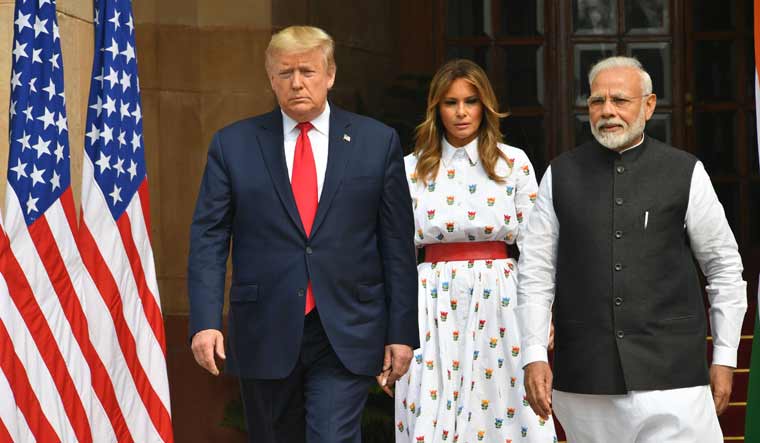
From Iran’s foreign minister Javad Zarif to its supreme leader Ayatollah Khameini, Iranian officials have increasingly taken to condemning India in the wake of the Delhi violence that left 53 dead at latest count. Now, the spokesman for the Iranian parliament’s national security and foreign policy commission is the latest to issue a strong statement, blaming US President Donald Trump for changing India’s attitude.
Naqavi Hosseini told Iranian news agency Tasnim that the “mass killing” of Muslims was taking place in India, and that India’s attitude towards the Muslim community changed after US President Donald Trump’s visit to India.
“Today, we are witnessing the mass killing of Muslims in India, which must be strongly condemned by the international community and Islamic countries,” Hosseini said
“I believe that since President Trump travelled to India and met with its officials, the country’s behaviour… toward the Indian Muslim community changed,” he said.
“The Islamic Republic of Iran and its diplomatic apparatus should use the capacities of the Organization of Islamic Cooperation and the Non-Aligned Movement to counter the killing of Muslims in India,” he continued.
According to Tasnim, he said that the “crimes by extremists against the Indian Muslims” indicate that the “New Delhi government is ingratiating itself with the American officials”. He also said that inaction on these crimes was a source of shame for Indian statesmen.
Hosseini’s comments come days after Ayatollah Khamenei called on India to stop the “massacre of Muslims”. On March 5, Khamenei had tweeted, “The hearts of Muslims all over the world are grieving over the massacre of Muslims in India. The govt of India should confront extremist Hindus & their parties & stop the massacre of Muslims in order to prevent India’s isolation from the world of Islam.”
Earlier, foreign minister Zarif had tweeted, “Iran condemns the wave of organised violence against Indian Muslims. For centuries, Iran has been a friend of India. We urge Indian authorities to ensure the wellbeing of ALL Indians & not let senseless thuggery prevail. Path forward lies in peaceful dialogue and rule of law.” The statement prompted India to summon the Iranian ambassador, with MEA spokesperson Raveesh Kumar saying that it was conveyed that such “selective and tendentious characterisation of recent events in Delhi” were unacceptable. “We do not expect such comments from a country like Iran,” he said.
India has not yet reacted formally to Khamenei’s tweet. However, at a summit on March 7, external affairs minister S. Jaishankar responded to a question on whether India was losing friends in the world. “Maybe we are getting to know who our friends really are,” ANI reported him as saying.
Jaishankar also responded to the UNHCR’s move to approach the Supreme Court to challenge the Citizenship (Amendment) Act (CAA), saying that the UN body had been wrong before. He cited their record on Kashmir, saying, “They carefully skirt around the problem of cross-border terrorism in the region as if it has nothing to do with Kashmir.”
India enjoys strong bilateral ties with Iran, with strategic tie-ups such as with the Chabahar port. However, India’s growing ties with the US have also come in the way of relations. Under US pressure, India reduced all oil imports from Iran to zero in April 2019, choosing to rely on alternate source.
The move came after the US withdrawal from the 2015 nuclear deal revived a range of sanctions against Iran. India was part of a group of eight countries that had a six-month waiver from these sanctions, which was set to expire in May 2019.
Likewise, when the commander of Iran’s Quds force was assassinated in January, India sought to balance relations with both Iran and the US, reaching out to both sides in the aftermath and seeking to ensure that the Chabahar Port project continued.
As Iran struggles to battle the coronavirus outbreak in the country, India has been working closely with Iran to ensure its nationals are able to leave the country safely and vice versa.
from Indian Defence Research Wing https://ift.tt/39CWcxs
via IFTTThttp://idrw.org

No comments:
Post a Comment